How to Create Custom QR Codes for Business
Generate professional QR codes with custom colors, logos, and error correction. Perfect for marketing, menus, and events.
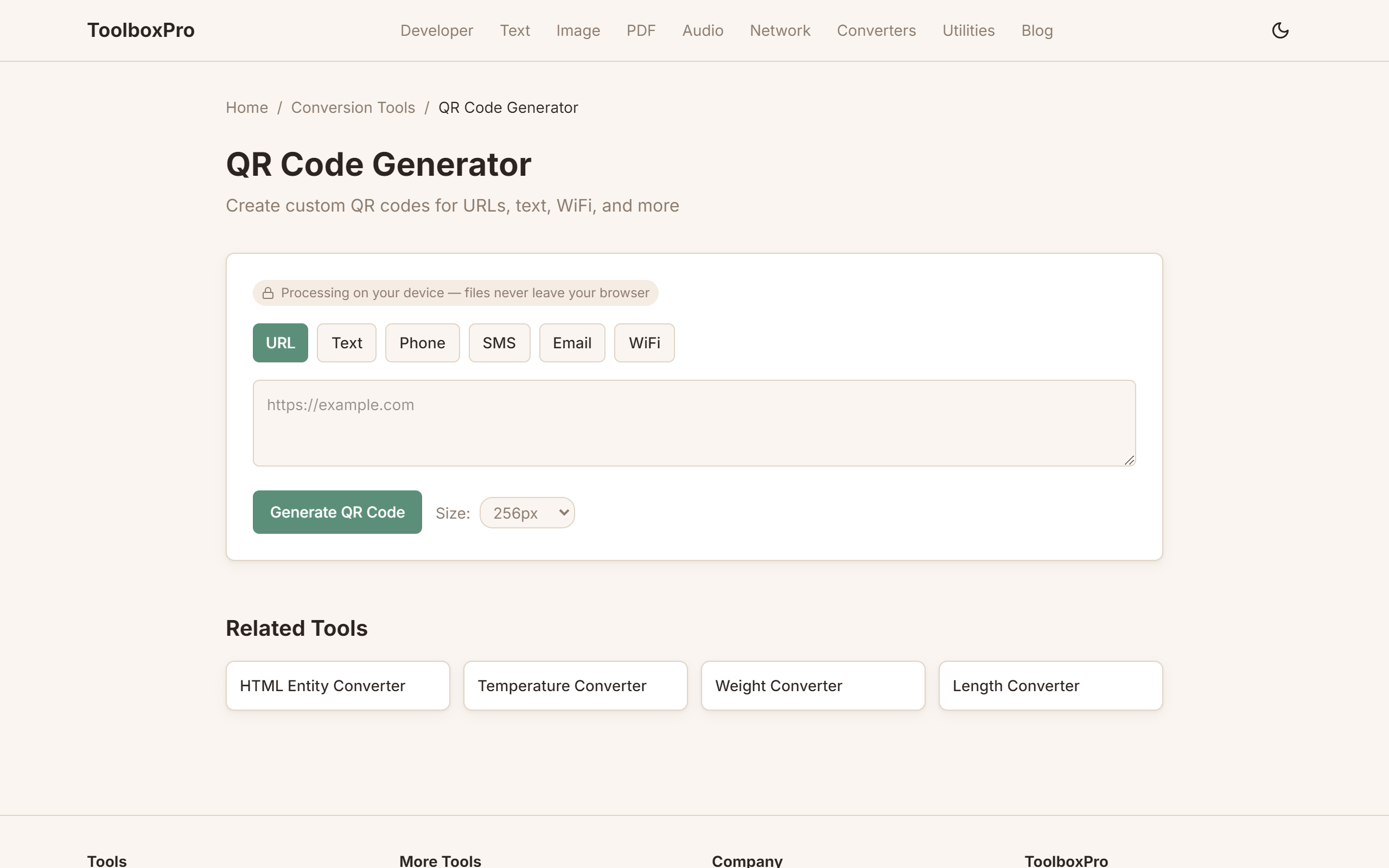
What Is a QR Code and How It Works
A QR code (Quick Response code) is a two-dimensional barcode that stores information in a pattern of black squares on a white background. Unlike traditional barcodes holding data in one direction, QR codes encode both horizontally and vertically, storing up to 4,296 alphanumeric characters or 7,089 numeric digits.
QR codes were invented in 1994 by Denso Wave, a Toyota subsidiary, for tracking automotive parts during manufacturing. The key innovation was speed: QR codes decode about 10 times faster than standard barcodes. They entered consumer mainstream with the smartphone era, when every phone camera became a potential scanner. Today, QR codes are ubiquitous — on restaurant menus, product packaging, event tickets, payment terminals, and advertising billboards.
QR Code Types and Data Capacity
There are 40 QR code versions (Version 1 at 21×21 modules to Version 40 at 177×177). Higher versions store more data. Four encoding modes exist:
| QR Version | Numeric | Alphanumeric | Byte | Kanji |
|---|---|---|---|---|
| 1 | 41 | 25 | 17 | 10 |
| 10 | 652 | 395 | 271 | 79 |
| 40 | 7,089 | 4,296 | 2,953 | 1,817 |
Error Correction Levels
QR codes use Reed-Solomon error correction with four levels:
Higher error correction means larger QR codes for the same data. Experiment with settings in a QR code generator to find the right balance.
How QR Code Scanning Works
Modern smartphones scan QR codes through the built-in camera decoder (iOS 11+ and Android 8+ both support native scanning). The process: the camera detects the three finder patterns (corner squares) to determine orientation, samples the module grid converting dark/light to binary data, applies Reed-Solomon error correction, extracts format info (mask pattern and error level), decodes the remaining data, then executes the appropriate action (open URL, display text, add contact, connect to Wi-Fi).
Common QR Code Use Cases
Contactless Payments — UPI, Alipay, WeChat Pay, and European payment systems use QR codes at point-of-sale for fast, secure transactions.
Wi-Fi Sharing — QR codes encode SSID, password, and encryption type so guests scan to connect without typing. Many modern routers generate Wi-Fi QR codes by default.
Event Ticketing — Airlines, cinemas, and concerts use QR codes on digital tickets. Unique encoding prevents duplication and speeds entry validation. Restaurant Menus and museum labels also use QR codes for contactless access to digital content.
Marketing and Tracking — QR codes on print ads and packaging link to UTM-tagged landing pages, allowing marketers to measure scan-to-visit conversion.
If you need to generate custom QR codes with your brand colors or a logo in the center, a custom QR code maker can handle that while maintaining readability by adjusting error correction appropriately. For bulk generation, use a dedicated QR code generator.
QR Code Security Considerations
QR codes can be exploited for "quishing" (QR + phishing) attacks — malicious codes that lead to phishing sites, malware downloads, or credential harvesting. Since some devices open URLs automatically after scanning, always inspect the URL before navigating. Use a scanner that previews the URL before redirecting.
FAQ
Can QR codes be scanned without an app? Yes. Most modern smartphones (iOS 11+ and Android 8+) include native QR scanning in the camera app. No additional app is needed.
Do QR codes expire? No. The QR image is static — it never expires. However, if the encoded URL's destination is taken down, the link breaks. Dynamic QR codes let you change the redirect URL without reprinting.
What is a dynamic QR code? It encodes a short redirect URL pointing to a server. The admin can change the final destination anytime without reprinting, and scan analytics are trackable.
Can I add a logo to a QR code? Yes, but increase error correction to Level Q or H so the logo doesn't corrupt data. The logo should cover no more than 15–20% of the total area.
How small can a QR code be printed? The module size should be at least 1/10th of the scanning distance. For phone scanning at 10 cm, each module needs 1 mm minimum, giving a minimum QR size of about 2×2 cm.
What colors can a QR code be? Any dark color on a light background works — the scanner detects contrast, not specific colors. Minimum contrast ratio is 3:1 (recommended 4.5:1).
Are QR codes patent-protected? No. Denso Wave chose not to enforce its patents. QR codes are an open standard (ISO/IEC 18004) free to generate and scan without licensing.
Advanced Tips
Error Correction Level Selection
QR codes use Reed-Solomon error correction with four levels. Understanding when to use each one is critical for production output:
Logo Embedding Best Practices
To embed a logo without breaking scannability: crop the logo to a square, center it, and keep its footprint under 20% of the total QR area (15% is safer). Convert the logo to a monochrome or limited-color version — full-color logos with gradients reduce contrast against the QR modules. Add a quiet zone (white margin) of at least 4 modules around the entire code, and a solid white background patch behind the logo so it doesn't blend into the data pattern. Test with at least three different scanner apps after embedding.
Scanning Distance Optimization
The relationship between physical size and scannable distance follows a 10:1 rule — the scanning distance is roughly 10 times the QR code's physical width. A 2-inch QR code scans reliably from about 20 inches (50 cm). For a billboard scanned from 5 meters away, you need a code at least 50 cm wide. Module density also matters: Version 10 (57×57 modules) requires more physical space per module than Version 4 (33×33) for the same scanning distance. When in doubt, generate a smaller version and scale the physical print larger rather than cramming more data into a small print.
Common Mistakes
Real-World Use Cases
Try it yourself with our free online tool:
Try How to Create Custom QR Codes for Business →