Text Case Converter: Upper, Lower, Title, CamelCase and More
Convert text between uppercase, lowercase, title case, camelCase, snake_case, kebab-case, and more. A complete guide to text case formats in programming.
Why Text Case Matters
Every programming language and framework has conventions for naming variables, files, and functions. Using the wrong case can break your code or confuse collaborators.
The Most Common Cases
| Case | Example | Where It's Used |
|---|---|---|
| **camelCase** | \`myVariableName\` | JavaScript, Java, TypeScript variables |
| **PascalCase** | \`MyComponentName\` | React components, C# classes, TypeScript types |
| **snake_case** | \`my_variable_name\` | Python, Ruby, Rust variables |
| **SCREAMING_SNAKE_CASE** | \`MAX_RETRY_COUNT\` | Constants, environment variables |
| **kebab-case** | \`my-component-name\` | HTML files, CSS classes, npm packages |
| **Train-Case** | \`My-Component-Name\` | HTTP headers (e.g., \`Content-Type\`) |
| **dot.case** | \`my.component.name\` | Java package names, file extensions |
How to Convert Between Cases
Using ToolboxPro
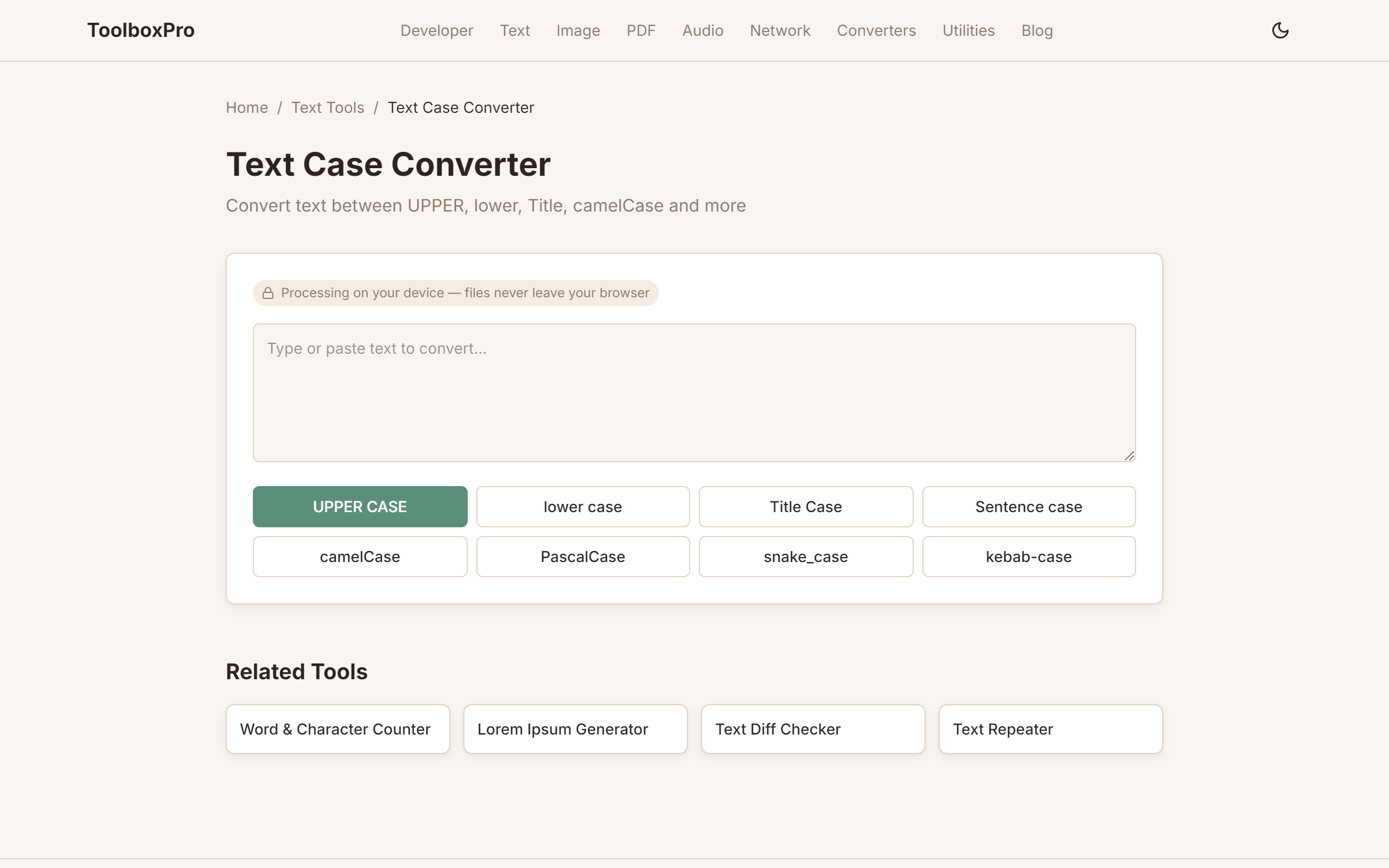
Visit our Case Converter and:
1. Type or paste your text in the input
2. See all cases simultaneously — live preview as you type
3. Click any result to copy it to your clipboard
4. Works with multi-word phrases — just type naturally with spaces
JavaScript Manual Conversion
\\\`javascript
// camelCase
"hello world".replace(/(?:^|\s+)(\\w)/g, (_, c) => c.toUpperCase())
.replace(/\\s+/g, '')
.replace(/^(.)/, c => c.toLowerCase());
// Result: "helloWorld"
// PascalCase (same as camelCase but first letter uppercase)
"hello world".replace(/(?:^|\\s+)(\\w)/g, (_, c) => c.toUpperCase())
.replace(/\\s+/g, '');
// Result: "HelloWorld"
// snake_case
"hello world".toLowerCase().replace(/\\s+/g, '_');
// Result: "hello_world"
// kebab-case
"hello world".toLowerCase().replace(/\\s+/g, '-');
// Result: "hello-world"
// SCREAMING_SNAKE_CASE
"hello world".toUpperCase().replace(/\\s+/g, '_');
// Result: "HELLO_WORLD"
// Title Case
"hello world".replace(/\\w\\S*/g, w => w.charAt(0).toUpperCase() + w.slice(1).toLowerCase());
// Result: "Hello World"
\\\`
Case Conventions by Language
JavaScript / TypeScript
\\\`typescript
// camelCase — variables and functions
const userName = "Alice";
function fetchUserData() {}
// PascalCase — classes and components
class UserService {}
function UserCard() {}
// SCREAMING_SNAKE_CASE — constants
const MAX_FILE_SIZE = 10 * 1024 * 1024;
// kebab-case — file names
// user-profile.tsx, api-utils.ts
\\\`
Python
\\\`python
# snake_case — everything except classes
user_name = "Alice"
def fetch_user_data():
# PascalCase — classes only
class UserService:
# SCREAMING_SNAKE_CASE — constants
MAX_FILE_SIZE = 10 * 1024 * 1024
\\\`
CSS / HTML
\\\`css
/* kebab-case — CSS classes and IDs */
.user-profile-card {
background-color: #fff;
font-family: "Inter", sans-serif;
}
/* camelCase — custom properties (modern CSS) */
:root {
--primaryColor: #3498db;
--borderRadius: 8px;
}
\\\`
Special Cases
Acronyms
There's debate about how to handle acronyms in camelCase:
\\\`
// Option A: All caps
parseJSON, HTMLParser, fetchURL
// Option B: Camel-cased
parseJson, HtmlParser, fetchUrl
// Both are used. Pick one and be consistent.
// The most common convention:
// JavaScript: camelCase acronyms (parseJson)
// C#: PascalCase acronyms (ParseJSON)
\\\`
Numbers in Identifiers
\\\`
// Variables can contain numbers but not start with them
user2, item3_name // ✅ valid
2user, 3rd_item // ❌ invalid in most languages
\\\`
Reserved Words
\\\`javascript
// Can't use reserved words as variable names
// ❌ let class = "math";
// ✅ let className = "math";
// ❌ let default = "value";
// ✅ let defaultValue = "value";
\\\`
Common Conversion Mistakes
1. Losing Information
\\\`
// Converting to lower case loses title case info
"McDonald" → lowercase: "mcdonald" → title case: "Mcdonald" ❌
// Our tool handles edge cases like this with special rules
\\\`
2. Double Converting
\\\`
// Already camelCase, converting to snake_case then back
"myVariable" → snake_case: "my_variable" → camelCase: "myVariable" ✅
// But watch out:
"myVariable" → lower case: "myvariable" → camelCase: "myvariable" ❌
\\\`
3. Locale Issues
\\\`
// Turkish 'i' and 'I' behave differently
// 'i'.toUpperCase() in Turkish locale → 'İ'
// Our tool uses locale-independent conversion
\\\`
FAQ
What's the difference between camelCase and PascalCase? PascalCase capitalizes the first letter too: \CamelCase\ vs \camelCase\. Use PascalCase for classes and React components, camelCase for variables and functions.
Which case should I use for database column names? Most databases use snake_case (\user_name\, \created_at\) because it's SQL-standard and case-insensitive in most engines. PostgreSQL folds unquoted identifiers to lowercase, so \UserName\ becomes \username\ — a common source of confusion.
Naming Conventions Across Languages Compared
Different ecosystems have deeply entrenched conventions. Violating them makes your code feel foreign to other developers:
| Language | Variables | Functions | Classes | Constants | Files |
|---|---|---|---|---|---|
| **JavaScript/TS** | camelCase | camelCase | PascalCase | SCREAMING_SNAKE | kebab-case |
| **Python** | snake_case | snake_case | PascalCase | SCREAMING_SNAKE | snake_case |
| **Java** | camelCase | camelCase | PascalCase | SCREAMING_SNAKE | PascalCase |
| **Go** | camelCase | PascalCase (exported) | PascalCase | SCREAMING_SNAKE | snake_case |
| **Rust** | snake_case | snake_case | PascalCase | SCREAMING_SNAKE | snake_case |
| **C#** | camelCase | PascalCase | PascalCase | PascalCase | PascalCase |
| **Ruby** | snake_case | snake_case | PascalCase | SCREAMING_SNAKE | snake_case |
Go's convention is unique: exported (public) identifiers use PascalCase, unexported (private) ones use camelCase. The case of the first letter IS the visibility modifier — there are no \public\ or \private\ keywords.
When Languages Collide
Full-stack projects often span multiple conventions. A typical setup: Python backend with \user_name\ in the API → JavaScript frontend expecting \userName\. Two solutions:
1. Transform at the API boundary — convert all keys to camelCase in your API response layer before sending to the frontend.
2. Use a shared schema — generate types from OpenAPI/Swagger and let code generators handle the conversion.
\\\`javascript
// Converting API response keys from snake_case to camelCase
function toCamelCase(obj) {
return Object.fromEntries(
Object.entries(obj).map(([key, value]) => [
key.replace(/_([a-z])/g, (_, c) => c.toUpperCase()),
value
])
);
}
\\\`
Bulk Renaming Tools and Techniques
When refactoring a codebase from one naming convention to another, manual find-and-replace is error-prone. Here are reliable approaches:
VS Code (Built-in)
Use Find and Replace with regex (Ctrl+H, enable regex with \.*\ icon):
Command-Line Tools
\\\`bash
# Install the 'change-case' CLI tool
npm install -g change-case
# Batch rename files in a directory
for f in *.js; do
new_name=$(echo "$f" | sed -E 's/([a-z])([A-Z])/\1-\2/g' | tr '[:upper:]' '[:lower:]')
mv "$f" "$new_name"
done
\\\`
IDE Refactoring (Safest)
IntelliJ, WebStorm, and VS Code's TypeScript language server support Rename Symbol (F2), which renames all references across the project. This is safer than text-based find-and-replace because it understands scope.
SEO and URL Case Sensitivity
URLs are technically case-sensitive after the domain, but the convention matters for SEO:
\\\`nginx
# Nginx: force lowercase URLs
if ($request_uri ~ [A-Z]) {
return 301 https://$host$request_uri; # then lowercase via rewrite map
}
\\\`
Advanced Tips
Try it yourself with our free online tool:
Try Text Case Converter: Upper, Lower, Title, CamelCase and More →